
Exclusive Interview:A 400-Year Encounter,A Buried China–Australia Friendship Is Being Seen Again

They Were Searching for Napoleonic Treasure —
But the Detector Sounded on a Ming–Qing Dynasty Buddha

🎙️ About the Interviewees
They are not archaeologists.They are not museum professionals.
They are two people who have spent years travelling through some of the most remote regions of Australia.
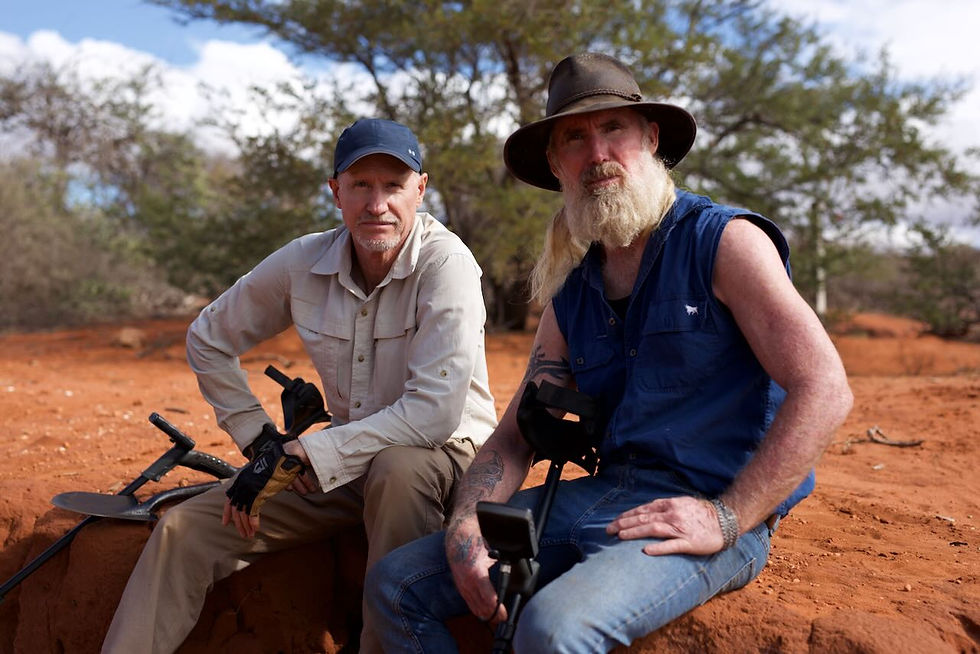
Leon Deschamps
A remote exploration guide and four-wheel-drive specialist,with deep expertise in survival skills and traditional Australian bush medicine.
Shayne Thomson
A metal-detection and treasure-hunting specialist,an experienced commercial camera operator,and a CASA-certified drone pilot.
01 | Searching for Napoleon, Encountering China
In 2018,in the remote region of Shark Bay, Western Australia,Shane and Leon — filmmakers and amateur explorers —were walking back and forth across the red earth with metal detectors in hand.
Their goal was clear, and very Australian:to search for the legendary Napoleonic-era treasure,believed to have been lost by a French expedition in this region.
Then —the detector sounded.
“The signal was strong, and very shallow,”Shane recalled.
He dug only a few centimetres into the sand.
There were no French coins.No European medals.
Instead, what emerged was a small statue,covered in dirt, yet unmistakably golden.
When Shane turned it over,he was momentarily speechless.
In the original field footage,he can be heard repeating the same word nearly twenty times:
“Wow… Wow… Wow…”
It was an Infant Buddha.

Only about 15 centimetres tall,yet surprisingly heavy —weighing over one kilogram.
At the time, they had no ideathat this accidental discoverywould completely change the course of their livesfor the next seven years.
02 | “They Said We Bought It on Taobao”
From Doubt to Scientific Truth

The excitement did not last long.
When Shane and Leon made the discovery public,they were met not with applause,but with overwhelming scepticism.
“People called us frauds,”Leon said during a phone interview.“They said we buried it ourselves for attention.Some even claimed it was a fake bought on Taobao.”
To uncover the truth —and to clear their names —they turned to Dr Ian MacLeod,a renowned metallurgist and former director of the Western Australian Museum.

Leon vividly remembers that first meeting.
“The doctor came in sceptical,” he said.“He probably thought we had either been fooled,or were trying to fool someone else.It felt like he planned to take a quick look and send us on our way.”
But the moment Dr MacLeod saw the statue,everything changed.
“His face lit up,” Leon recalled.“He walked straight across the roomand couldn’t wait to put it under the microscope.”

What was meant to be a brief inspectionturned into three hours of astonishment.
After detailed analysis of the metal composition and corrosion patterns,Dr MacLeod delivered a definitive conclusion:
✅ The statue is a genuine Ming dynasty artefact
✅ It had been buried underground in Western Australia for approximately 100–150 years
This was not an online fake.It was a piece of history.

03 | Tears and Custodianship
“It Belongs to the Community That Holds It Sacred”

Confirming the value of an artefact usually leads to one thing:auction. Profit.
But Shane and Leon chose a different path.
The turning point came through a friend —Nick, a highly respected Indigenous elder from the Shark Bay region.
When Shane placed the statue into Nick’s hands,the elder became visibly emotional,even moved to tears.
Nick explained that Indigenous communities understand deeplythe pain of having sacred objects taken,locked away in museums,and separated from the people who truly revere them.
Looking at the Buddha, he said:
“Sacred things should belong to the communitiesthat see them as sacred.”
Those words struck Shane and Leon profoundly.
Later, at the first Buddha’s Birthday celebration held at the Western Australian Parliament,many elders from the Chinese community were brought to tearsupon seeing the statue.
“That was the moment we realised,”they said,“this was no longer just a discovery —it was a responsibility.”
04 | The Cost
AUD $100,000 — For One Word
In a recent interview,Leon revealed a startling figure.
Over the past seven years,they have personally spent more than AUD $100,000.
On authentication.On conservation.On travel.On telling the story.
They are not wealthy individuals.That money was originally meant for documentary projectsand family life.
“We had to sit down with our families and have very serious conversations,”Leon admitted.“Do we keep spending moneyjust to prove this is real?”
The financial pressure was real.But they continued.
Guided by a Buddhist principle —do good deeds, speak good words, keep a good heart —they defined their role clearly:
❌ Not Owners
✅ But Custodians
05 | What Comes Next: Sending It Home

At the end of the interview,Shane and Leon shared their upcoming plans.
They are travelling to Perthto attend the Chinese New Year celebrations at the Western Australian Parliament,and to visit the Chinese Consulate-General in Perth.
Their hope is simple, yet profound:
That the statue may one day serve as a diplomatic gift,formally returned by the Australian governmentto the people of China,as a symbol of friendship between the two nations.
As Shane said:
“Its journey isn’t over yet.Maybe the next stopis returning to China —back to where it came from.”


Comments